
Background information
On 8 December 2022, the European Commission proposed a package of measures entitled ‘VAT in the digital age (ViDA)’ to modernise VAT, with the aim of modernising the EU’s VAT system, making it more efficient for businesses and more fraud-resistant by promoting digitalisation.
With its proposals, in particular those to amend the VAT Directive and the VAT Implementing Regulation, the Commission aims to address the discrepancy between the 30-year-old VAT rules and the current digital reality.
In order to be able to operate independently of the implementation of the proposed legislation on 'VAT in the Digital Age (ViDA)',
Germany had applied for a special measure under Article 395 of the VAT Directive, with the aim of being permitted to deviate from the current
European rules on invoicing.
The Growth Opportunities Act, containing the fundamental amendments to Section 14 of the German VAT Act (UStG), has since been
published in the Federal Law Gazette. From 1 January 2025, electronic invoicing will now become the norm for certain
domestic B2B transactions. For the invoice issuer, transitional provisions are in place until 31 December 2027,
which, amongst other things, continue to permit the issuing of paper invoices.
However, there are no specific simplifications for the invoice recipient. Should the supplier
wishes to issue an e-invoice in the cases specified by law, no consent
from the customer is required.
Companies must therefore prepare to
be able to receive e-invoices from 1 January 2025.



What you should know
The draft directive sets out three key areas of action (‘pillars’):
- the expansion of electronic invoicing, and the introduction of digital reporting obligations,
- the concept of a single VAT registration (Single VAT Registration) to avoid a multitude of local registrations in the Member States, as well as
- the extension of the supply chain presumption to online marketplaces involved in the short-term letting of accommodation or the provision of passenger transport services.
The introduction of digital reporting obligations to the tax authorities, together with the expansion of electronic invoicing, will lead to the modernisation of VAT reporting obligations in a phased manner. Until now, the issuing of electronic invoices has been dependent on the recipient’s acceptance. From 2024, Member States may stipulate that invoices must be issued electronically, whilst from 2028 onwards, electronic invoicing will be the norm and the use of paper invoices will be the exception. Under the proposals, from 2028 onwards, invoices for intra-Community supplies and other cross-border B2B transactions subject to the reverse charge mechanism must be issued within two working days of the transaction taking place.
Also from 2028, the recapitulative statement in its current form will be replaced. For intra-Community supplies, intra-Community acquisitions and other cross-border B2B transactions subject to the reverse charge mechanism, a corresponding electronic return must be submitted to the tax authorities within a further two working days of the invoice being issued.
The need for multiple VAT registrations within the EU is to be avoided.
By extending the existing ‘one-stop shop’ reporting systems (OSS and IOSS) to cover the reverse-charge mechanism, the aim is
to achieve what is known as a ‘single VAT registration’.
These changes will apply from 2025 and will, amongst other things,
enable compliance with reporting obligations in view of the expiry across Europe on 31 December 2025 of the consignment stock
scheme under Article 17a of the VAT Directive (or Section 6b of the German VAT Act).
The regulations governing the so-called (internet) platform economy are being revised with regard to the determination of the place of turnover and the increased involvement of platforms in the collection of VAT in the area of short-term accommodation rentals or the provision of passenger transport services. To this end, from 2025 onwards, a tax-exempt supply by the service provider to the operator of the electronic interface, whilst at the same time a corresponding supply of services by the interface operator to the customer would be deemed to have taken place. This turnover would then be regarded as taxable and the interface operator would be required to charge the customer VAT.
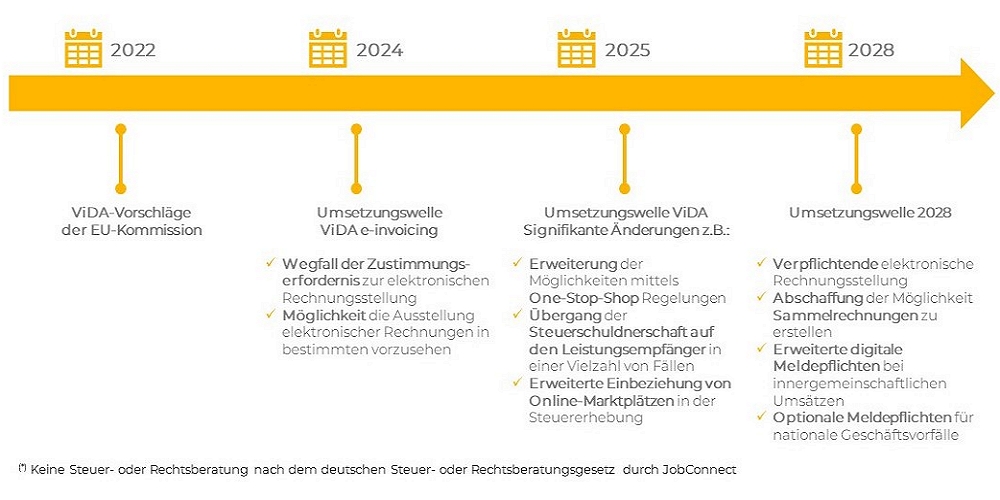
The entry into force of the planned amendments is subject to approval by the EU Member States. If the proposals are adopted unchanged or with only minor amendments, their implementation will result in fundamental changes – including to German – VAT law.
In view of the so-called ‘single VAT registration’, businesses operating in the cross-border B2B sector could benefit from no longer having to register for VAT abroad and the associated costs. The same applies to businesses operating as online retailers and selling their goods and services via online marketplaces. However, the complexity of the proposed changes requires a detailed analysis of business transactions to determine, on the one hand, whether it is possible to benefit from these simplifications and, on the other hand, how this will affect other local business activities, for example with regard to the claiming of input tax.
In Germany in particular, alongside the widespread introduction of electronic invoices and shorter deadlines for invoicing, there would also be extremely tight deadlines for reporting to the tax authorities. In addition to the tax authorities, the majority of businesses could also be affected by a significant need to adapt. Affected businesses would, amongst other things, have to ensure that their data infrastructure allows for invoicing at such short notice and that invoices can be generated electronically in a format compatible with their IT or ERP systems. Accordingly, the necessary capacity to receive incoming electronic invoices would also have to be ensured. In addition, IT adjustments would then have to be made to enable the transmission of digital reports to the tax authorities.
Companies should therefore promptly assess the extent to which their business model would be affected by these measures in order to be able to estimate the need for and cost of the transition.